Automatic Cat Toys: 7 Smart Picks for Bored Indoor Cats
Automatic cat toys are battery-powered or rechargeable toys that move, flash, or dispense treats on their own to trigger a cat’s hunting instinct. They matter most for indoor cats left alone for long workdays, and for cats that need extra exercise between your own play sessions.
This post may contain affiliate links. As an Amazon Associate I earn from qualifying purchases.
Table of Contents
Automatic cat toys at a glance:
- Short Answer: Automatic cat toys keep cats active and mentally busy while you are away, but they work best as a supplement to live play, not a replacement.
- Best For: Indoor cats, kittens with high energy, and single-cat homes with long absences.
- Key Feature to Look For: Unpredictable movement, an automatic shut-off timer, and a quiet motor.
- What to Avoid: Toys with loose strings, small detachable parts, or constant fixed patterns that bore cats within days.
- Typical Lifespan or Care: Most last one to three years with regular battery changes and a monthly wipe-down.
Why Automatic Cat Toys Help Indoor Cats
Automatic cat toys give indoor cats a safe outlet for stalking, chasing, and pouncing. Cats are natural predators that evolved to hunt many small meals a day, and a closed apartment offers very few chances to do that.
Without an outlet, boredom often shows up as problem behavior. Cats may scratch furniture, cry at night, overgroom, or ambush ankles. Our guide on common cat behavior problems shows how often under-stimulation sits behind these habits.
A good toy also supports weight control. An indoor adult cat generally benefits from two or three play sessions a day of about 10 to 15 minutes each. Automatic toys can cover the gaps when you are at work.
Many owners pair them with other enrichment, as covered in how to keep an indoor cat entertained. Variety matters more than any single gadget.
7 Types of Automatic Cat Toys Worth Considering
Seven main types of automatic cat toys exist, and each suits a different personality. Pick the type that matches how your cat already likes to play.
1. Rolling Ball Toys
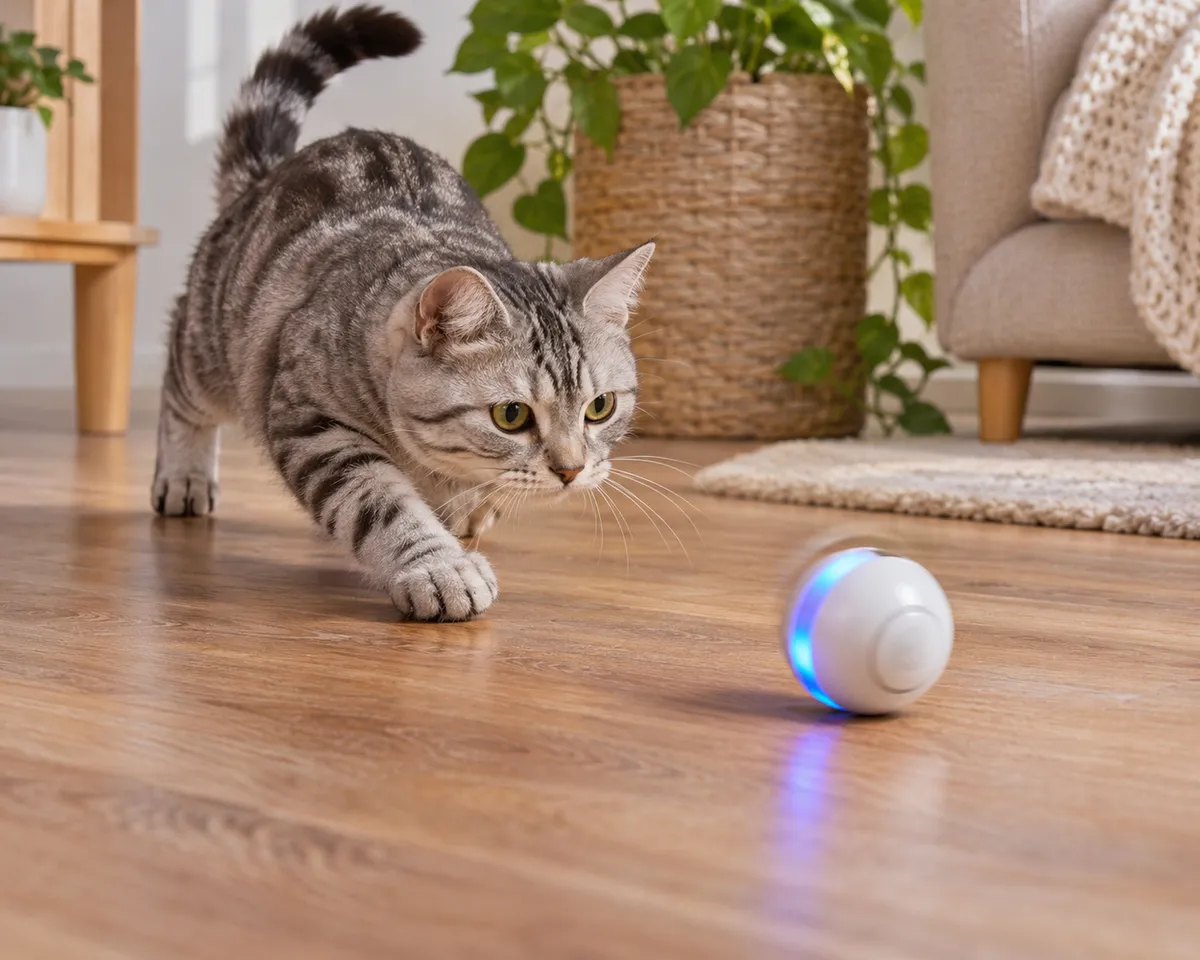
Rolling ball toys contain a motor or motion sensor that sends the ball skittering across the floor in random directions. They suit cats that love to chase and bat objects. Look for a ball with a bumper-style shell that bounces off furniture instead of getting stuck.
2. Rotating Feather and Wand Toys
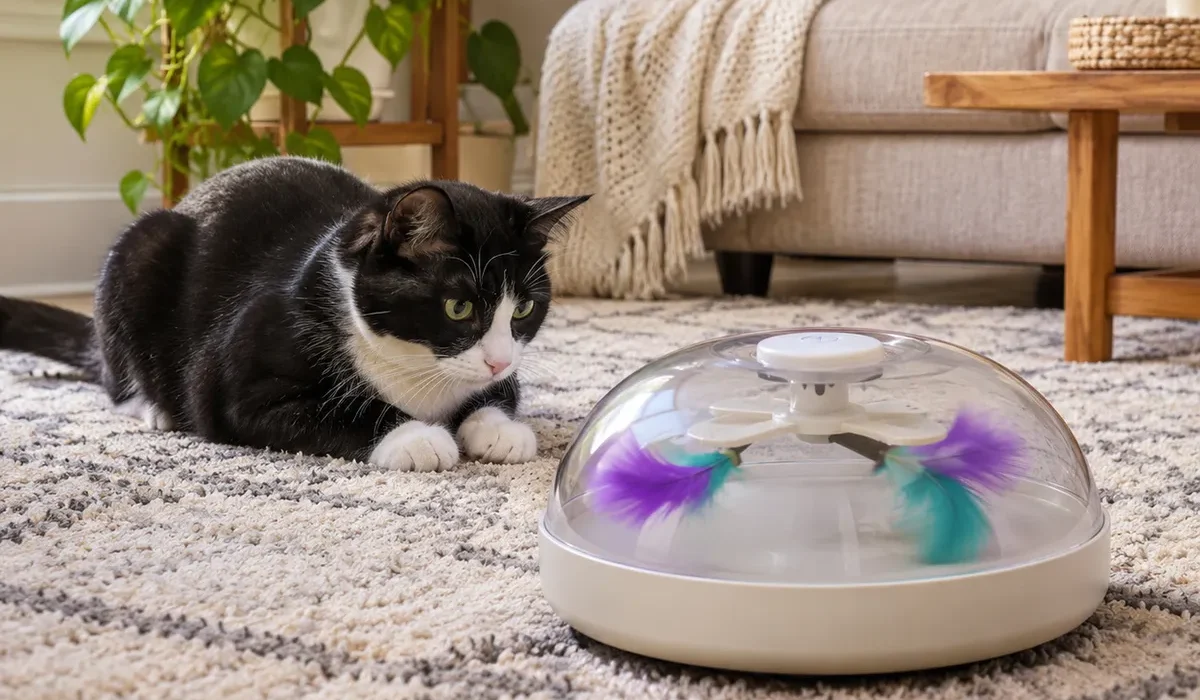
These toys spin a feather or ribbon on a short arm, mimicking a bird in flight. Cats that jump and swat tend to love them. Choose one with a replaceable attachment, because feathers wear out fast.
3. Laser Toys
Automatic laser toys project a dot that wanders across walls and floors. They create intense chasing, but cats never actually catch the dot, which can cause frustration in some cats. End each session with a real toy or a treat so your cat gets the satisfaction of a “kill.”
4. Hidden Mouse and Burrow Toys
These toys hide a small mouse or tail that darts in and out of holes or under fabric. They appeal to ambush hunters that love to wait, wiggle, and pounce. The moving target stays partly hidden, which keeps interest high.
5. Treat-Dispensing Toys
A treat-dispensing toy releases a few kibbles when your cat rolls, pushes, or taps it. It combines play with a food reward, which works well for food-motivated cats. Count the treats toward your cat’s daily calories to avoid weight gain.
6. Interactive Track Toys
Track toys hold a ball in a circular plastic ring that cats bat with a paw. They are quiet, simple, and often need no batteries. Because the ball cannot leave the track, they are a low-risk option for small homes.
7. Smart App-Controlled Toys
Smart toys connect to a phone so you can change speed, schedule play, or trigger movement while away. Some include a camera. They cost more, but they let you adjust the pattern before your cat gets bored.
How to Choose Automatic Cat Toys for Your Cat
The best automatic cat toys match your cat’s age, energy level, and play style. A toy that thrills a two-year-old Bengal may frighten a shy senior cat.
Match the toy to your cat:
- Kittens (under 1 year): choose slow, small, soft toys with no loose parts.
- Adult cats (1 to 10 years): choose faster, unpredictable movement and hiding elements.
- Seniors (10+ years): choose gentle, low-effort toys like slow tracks and treat puzzles. See our senior cat care tips for more on adjusting activity.
- Shy cats: choose quiet motors that move in short bursts.
Features worth paying for:
- Automatic shut-off, so the motor does not run for hours and burn out.
- Random movement patterns instead of one repeating loop.
- Rechargeable battery with a USB port, which saves money over time.
- Washable or replaceable parts.
- Noise level low enough that it will not wake you at night.
For cats that like to hunt, a rolling ball toy with a random motion sensor is often the easiest first purchase. If your cat is motivated by food, a treat-dispensing puzzle toy adds a second layer of enrichment.
Safety Checks Before You Leave Automatic Cat Toys Alone
Automatic cat toys are safe only when they have no strings, loose threads, or small parts that your cat can swallow. Linear foreign bodies, like string or ribbon, can cause serious intestinal injury and need emergency veterinary care.
Run through this checklist before leaving a new toy unattended:
- Watch your cat use the toy for at least three sessions while you are home.
- Check for frayed fabric, cracked plastic, or exposed battery compartments.
- Remove any dangling feathers, strings, or ribbons.
- Confirm the toy cannot trap a paw, tail, or whisker.
- Place it on a hard, flat surface away from stairs, cords, and open water.
Most automatic toys are designed for supervised or time-limited use. A toy that auto-stops after 10 to 15 minutes is much safer than one that runs all day. If your cat vomits or stops eating after chewing a toy, call a veterinarian promptly.
How to Introduce Automatic Cat Toys Without Scaring Your Cat
Introduce automatic cat toys slowly, with the toy turned off at first. Many cats hide from a sudden buzzing or moving object, and a bad first experience can put them off for weeks.
Follow this simple process:
- Leave the toy switched off on the floor for a day so your cat can sniff and inspect it.
- Turn it on while you are in the room and let your cat watch from a distance.
- Reward curiosity with a treat or gentle praise.
- Run the toy for two or three minutes, then switch it off before your cat loses interest.
- Gradually lengthen sessions over the next week.
Never chase your cat with the toy or corner it. If your cat flattens its ears, puffs its tail, or runs away, stop and try a slower, quieter toy. Some cats simply prefer you to hold the wand, and that is fine.
Pairing automatic play with hands-on games gives the best results. Our tips on playing with your cat explain how to build short, rewarding sessions.
Automatic Cat Toys Compared by Cat Type
Different automatic cat toys fit different play styles, budgets, and homes. This quick comparison helps you narrow the choice.
| Toy Type | Best For | Noise Level | Main Drawback |
|---|---|---|---|
| Rolling ball | High-energy chasers | Low to medium | Can get stuck under furniture |
| Rotating feather | Jumpers and swatters | Low | Feathers wear out quickly |
| Laser | Active adult cats | Very low | No physical reward at the end |
| Hidden mouse | Ambush hunters | Low | Fabric can be chewed |
| Treat dispenser | Food-motivated cats | Low | Adds calories |
| Track toy | Small spaces, seniors | Very low | Easy to master quickly |
| App-controlled | Busy owners | Medium | Higher cost |
Keeping Cats Interested: Rotation and Homemade Options
Cats lose interest in any toy that stays the same, so rotating automatic cat toys is the single best way to keep them engaging. Store toys out of sight and swap them every three to four days.
Rotation works because novelty drives hunting behavior. A toy your cat ignored last week often feels brand new after a short break.
Budget-friendly options also help. You can make simple enrichment at home with a cardboard box, a paper bag, or a crinkle tunnel. Try some of the ideas in our DIY cat toys guide to add variety without spending much.
For broader ideas on non-electric options, see our overview of interactive toys for indoor cats. Mixing both styles gives your cat a richer routine.
Pairing play with a well-set-up space also helps. Vertical perches, hiding spots, and window views from indoor cat room ideas complement any toy you choose.
Cleaning and Maintaining Automatic Cat Toys
Clean automatic cat toys about once a month to remove saliva, hair, and dust that build up on surfaces. Hair wrapped around a motor shaft is the most common reason these toys stop working.
Monthly maintenance steps:
- Switch off the toy and remove the batteries.
- Wipe plastic surfaces with a damp cloth and mild, pet-safe soap.
- Pull hair and fuzz from moving parts with tweezers.
- Let everything dry fully before reassembling.
- Replace worn feathers, fabric tails, or cracked shells.
Check the battery compartment for corrosion, and never mix old and new batteries. Keep spare attachments on hand so you can replace a worn piece before your cat chews it apart.
For more veterinary guidance, see the Cornell Feline Health Center.
Frequently Asked Questions
Are automatic cat toys good for cats?
Yes, automatic cat toys are good for cats when used safely, because they encourage exercise and mental stimulation. They work best alongside 10 to 15 minutes of live play with you, two or three times a day.
Can I leave automatic cat toys on all day?
No, it is better to use toys with an automatic shut-off, since constant motion tires the motor and the cat. Sessions of 10 to 20 minutes, repeated a few times a day, are safer and more engaging.
How do I get my cat to play with an automatic toy?
Start with the toy switched off, then run it briefly while you sit nearby and reward curiosity with a treat. Most cats warm up within three to seven days if the toy is quiet and moves unpredictably.
Why does my cat ignore automatic cat toys?
Cats usually ignore automatic cat toys because the movement is too fast, too loud, or too predictable. Try a slower toy, rotate options every few days, or hide the toy partly under a blanket to mimic prey.
Are laser toys safe for cats?
Laser toys are generally safe if you never aim the beam at your cat’s eyes, but they can cause frustration because cats never catch the dot. Always finish a laser session with a physical toy or treat so your cat gets a satisfying end to the hunt.
Automatic cat toys are one of the easiest ways to keep a bored indoor cat active while you are away, as long as you choose safe designs and rotate them often. Start with one quiet toy that fits your cat’s play style, watch a few sessions, and pair it with daily hands-on play.