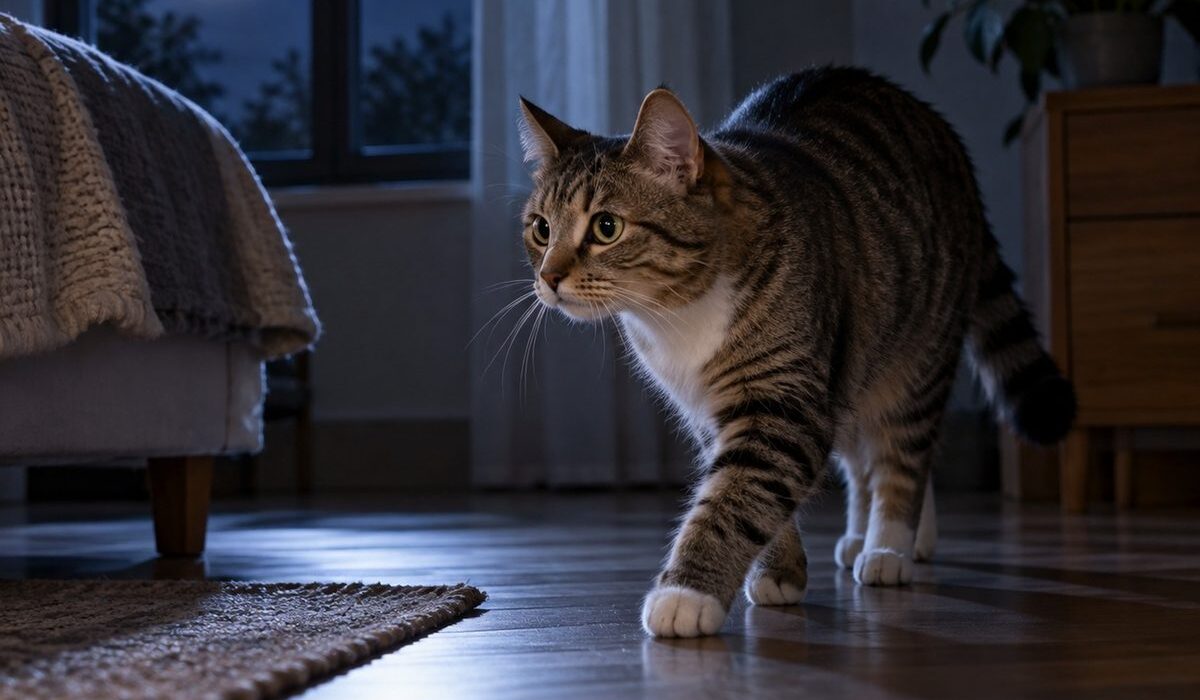
Can Cats See in the Dark? 7 Surprising Facts About Night Vision
This post may contain affiliate links. As an Amazon Associate I earn from qualifying purchases.
Can cats see in the dark? Not in total darkness, but cats see in light levels about six times dimmer than humans need, thanks to special eye structures built for hunting at dawn and dusk. This matters for every owner who wonders how a cat crosses a dim hallway without a single bump.
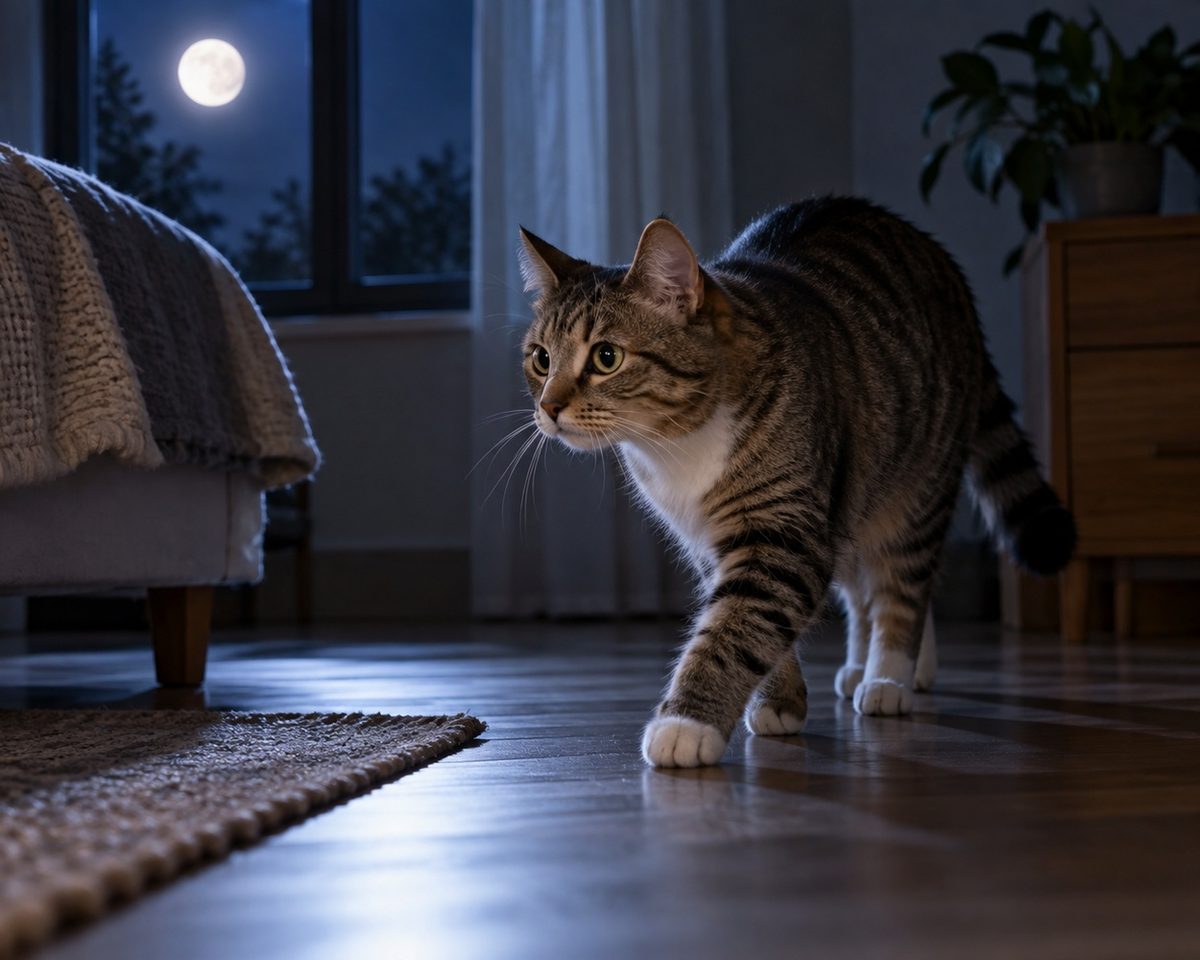
Can cats see in the dark at a glance:
- Short Answer: Cats see very well in dim light, but they cannot see in absolute darkness with zero light.
- Why Cats Do It: Large corneas, vertical slit pupils, a reflective layer called the tapetum lucidum, and a retina packed with rod cells.
- Light Needed: About one sixth of the light humans require to see shapes and movement.
- Trade-Off: Cats see fewer colors and less fine detail than people, and they struggle to focus on objects closer than about 10 inches.
- When to See a Vet: Dilated pupils that stay wide in bright light, bumping into furniture, or sudden clumsiness at night.
Table of Contents
How Cats See in the Dark: The Science of Night Vision
Cats are crepuscular, meaning they are most active at dawn and dusk, and their eyes evolved for exactly those low-light hours. Several features work together to gather and amplify every available photon.
- Large cornea and lens: A cat’s eye is large relative to its skull, so more light enters the eye than in a human eye.
- Vertical slit pupils: The pupil can open far wider than a round human pupil, and it can also narrow to a thin line in bright sun.
- Rod-rich retina: Rod cells detect dim light and motion, and cats have far more of them than cones.
- Tapetum lucidum: A mirror-like layer behind the retina bounces light back for a second pass through the photoreceptors.
When I first noticed my own cat tracking a moth across a room lit only by a hallway nightlight, I assumed she was guessing. She was not. Her eyes were doing precisely what evolution designed them to do.
Why Cat Eyes Glow: The Tapetum Lucidum Explained
The tapetum lucidum is the reason cat eyes flash green, yellow, or gold when a flashlight or camera flash hits them. It acts like a tiny mirror, reflecting light that passed through the retina back through it a second time.
This double pass gives the photoreceptors another chance to catch light. The result is a significant boost in sensitivity without needing a larger eye, which is a big part of why cats can see in the dark so much better than people.
Eye shine color varies by cat. Many cats show green or gold, while some blue-eyed cats and Siamese cats may show red or orange reflections because their tapetum is less developed or lacks pigment.
How Much Light Do Cats Need to See?
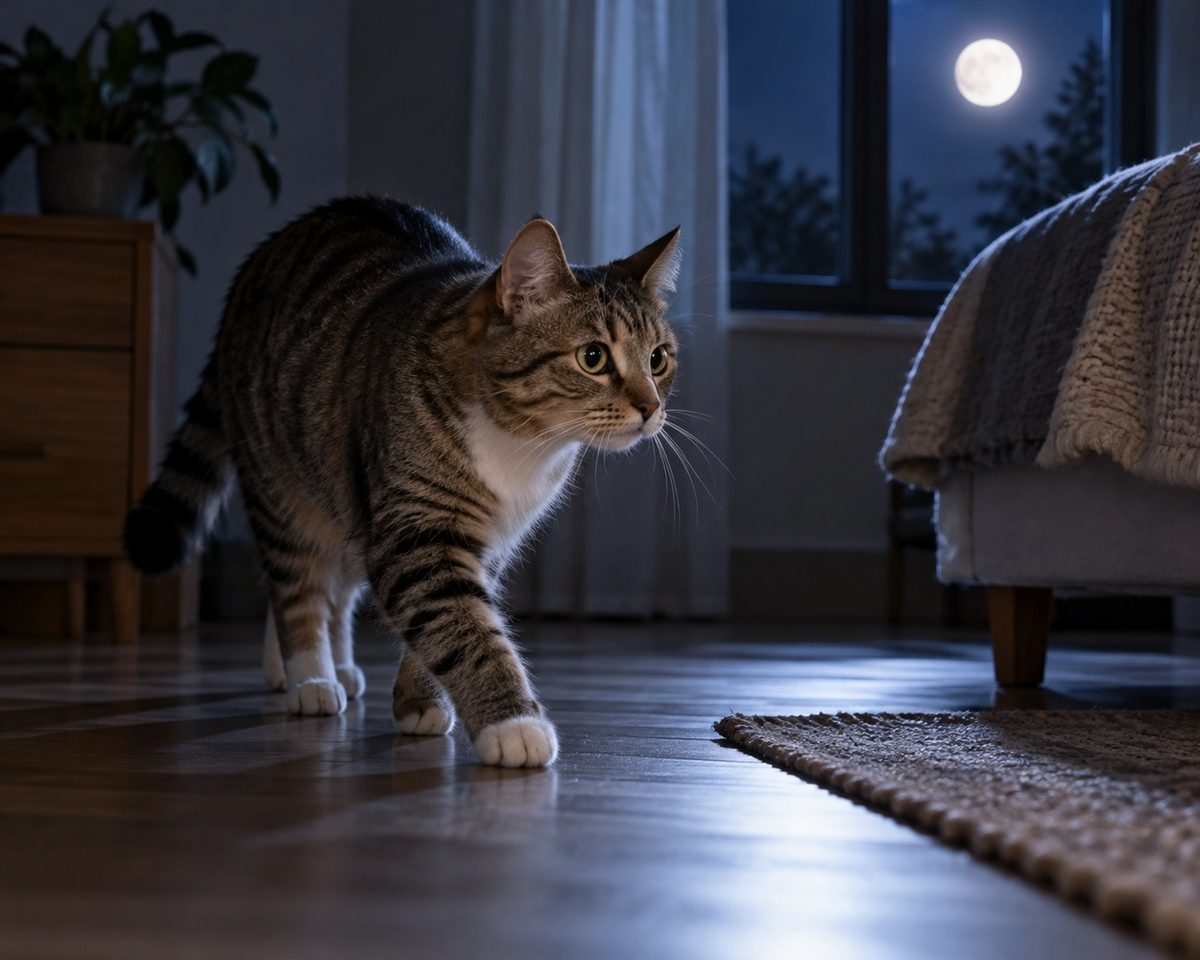
Cats cannot see in pitch black, because eyes cannot create an image without any light at all. What cats can do is make use of light levels that look completely dark to a person.
Research summaries commonly state that cats need roughly one sixth of the light a human needs to see well. A room that feels pitch dark to you often still holds enough starlight, moonlight, or glow from a window for your cat to navigate.
In a sealed windowless room with no light source, a cat is as blind as you are. Cats then rely more heavily on whiskers, hearing, and memory of the space.
Can Cats See in the Dark Better Than Humans and Dogs?
Cats see in dim light better than humans and, in most respects, slightly better than dogs. Dogs also have a tapetum lucidum, but cats have a higher rod density and a more extreme pupil range.
The trade-off is daytime sharpness. A cat sees at roughly 20/100 to 20/200 by human standards, so objects at a distance look blurrier to a cat than to you.
| Feature | Cats | Humans |
|---|---|---|
| Light needed to see | About 1/6 of human need | Baseline |
| Pupil shape | Vertical slit | Round |
| Reflective eye layer | Yes (tapetum lucidum) | No |
| Field of view | About 200 degrees | About 180 degrees |
| Color vision | Limited (blue and green range) | Full trichromatic |
| Close focus | Blurry under about 10 inches | Sharp at a few inches |
What Cats Cannot See Well: The Limits of Feline Vision
Excellent night vision comes with real limitations. Knowing them helps you set up a safer home.
- Limited color: Cats see mostly blues and greens, and reds and pinks look grayish.
- Weak close focus: Food right under the nose can be hard to see, which is why cats often locate treats by smell and by their whiskers.
- Lower detail: Fine patterns and distant objects look softer than they do to us.
- Slow adjustment to sudden light: Moving from bright light to dark takes a cat’s pupils a moment to expand.
Cats also use whiskers as a navigation tool in the dark. Each whisker senses tiny air currents and nearby objects, which fills the gap where vision falls short.
How Cats Move Around at Night
Vision is only one part of how a cat handles a dark house. Hearing, smell, and touch all work alongside the eyes.
A cat’s ears can rotate independently and detect high-pitched sounds far beyond human range. This is why your cat can pinpoint a mouse or a rustling toy behind a wall.
Cats also build detailed mental maps of their territory. After a few days in a home, a cat remembers where furniture sits and can cross the room confidently even with very little light.
Night Vision and Nighttime Behavior
Strong night vision explains a lot of what owners see after dark. Cats are wired for dim-light activity, so a burst of energy at 3 a.m. is normal feline biology rather than bad behavior.
If your cat is loud or restless in the evening, read about why cats meow at night for the common causes and fixes. Boredom is a big driver, and a pre-bedtime play session often helps.
- Play actively with your cat for 10 to 15 minutes in the evening.
- Feed a small meal right after play to mimic the hunt, catch, eat, sleep cycle.
- Offer a few quiet toys for solo play overnight.
- Keep one dim light or a window view available so your cat can see comfortably.
For more ideas on keeping a cat busy, see these strategies to keep an indoor cat entertained. A cat with a full evening routine tends to sleep better through the night.
Can Cats See in the Dark Without a Night Light?
Most healthy adult cats do not need a light left on, because they can see well in very dim conditions. A little ambient light from a window or hallway is usually enough.
A small plug-in LED night light can help kittens, senior cats, and cats with vision decline. A soft, low glow also makes it easier for you to avoid stepping on a paw at night.
If you have an older cat, extra light near stairs, the litter box, and the food bowl can prevent accidents. Make sure those areas stay clear of clutter after dark.
Signs Your Cat May Have Vision Problems
Because cats hide weakness well, vision loss often goes unnoticed for weeks. A cat that once seemed to see in the dark effortlessly but now hesitates at night may be losing sight. Watch for these changes, especially in senior cats.
- Pupils that stay widely dilated even in bright light
- Bumping into furniture, walls, or doorframes
- Hesitating to jump onto familiar surfaces
- Cloudy, bluish, or hazy eyes
- Startling easily when touched or approached from the side
- Increased hiding or reluctance to explore at night
Sudden blindness can be linked to high blood pressure, retinal detachment, or other medical problems. A cat showing sudden vision loss needs a veterinarian the same day. For related eye and body signs, you can also review signs a cat is in pain and common cat diseases and warning signs.
The Cornell Feline Health Center notes that regular veterinary check-ups help catch eye conditions early. Annual exams become especially valuable once a cat passes about age 10.
Helping a Cat With Poor Vision Feel Safe
Cats with reduced sight adapt remarkably well when the home stays predictable. Small changes make a big difference.
- Keep furniture and litter boxes in the same locations.
- Place food, water, and litter in easy-to-find, consistent spots.
- Use a cat ramp or pet stairs to replace risky jumps.
- Talk to your cat as you approach so you do not startle it.
- Avoid rearranging rooms, and block off unsafe stairs or balconies.
A tidy, routine environment lets a cat rely on memory and whiskers. Many blind cats live full, happy lives indoors with these simple adjustments.
Frequently Asked Questions
Can cats see in the dark in complete darkness?
No, cats cannot see in complete darkness because vision requires at least a trace of light. They can use light up to six times dimmer than humans need, so a room that feels black to you often still has enough glow for a cat.
Why do cats eyes glow in the dark?
Cat eyes glow because of the tapetum lucidum, a reflective layer behind the retina that bounces light back through the eye. This second pass improves night vision and creates the green or gold eye shine seen in flashlights and photos.
Do cats need a night light?
Healthy adult cats usually do not need a night light, since they see well in dim conditions. A soft light can help kittens, senior cats, and cats with vision loss move safely, especially near stairs and litter boxes.
What colors can cats see?
Cats see mainly blue and green shades, while reds and pinks appear gray or muted. Their color vision is similar to a human with red-green color blindness, which is a trade-off for superior low-light sensitivity.
How can I tell if my cat is going blind?
Signs include bumping into objects, constantly dilated pupils, cloudy eyes, and hesitation to jump. Any sudden change in vision is an emergency, so see a veterinarian immediately because conditions like high blood pressure can cause rapid vision loss.
So, can cats see in the dark? Almost, thanks to large pupils, a mirror-like tapetum, and a rod-rich retina that make dim light usable. Keep your home clutter-free after dusk, add a soft light for kittens and seniors, and book a vet visit if you notice sudden changes in your cat’s vision.